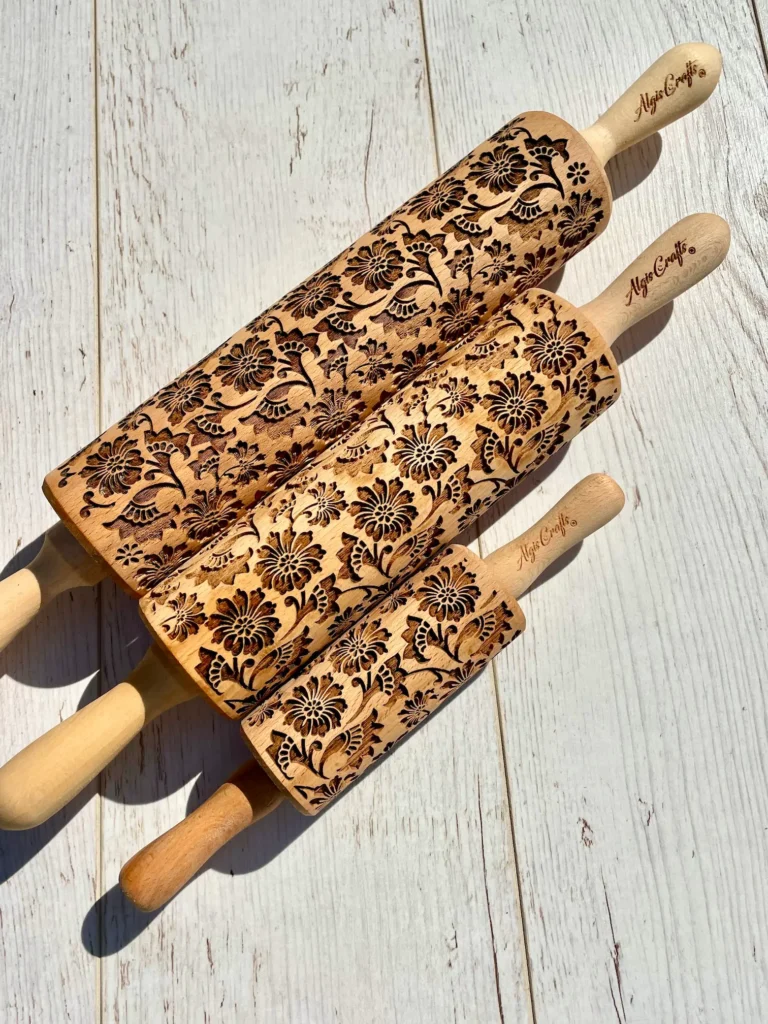
Rolling pin size comes down to three numbers: the total length, the length of the part that actually rolls, and the diameter. Our embossed rolling pins come as MINI at 24 cm (9.4 in), REGULAR (M) at 38 cm (15 in) and LARGE (L) at 43 cm (17 in) long, and the M is the right size for most home bakers. The size chart below lists every measurement in centimeters and inches.
We make our rolling pins in a few sizes because not every project needs the same amount of space. Sometimes you’re rolling out a quick batch of butter cookies, and sometimes it’s a wide clay slab that takes up the whole table.
Rolling pin size chart: MINI, M and L
| Size | Engraved pattern length | Total length | Diameter | Best for |
|---|---|---|---|---|
| MINI | 11 cm (4.3 in) | 24 cm (9.4 in) | 4.5 cm (1.8 in) | Kids, small batches, clay jewelry, trying a new pattern |
| REGULAR (M) | 20 cm (8 in) | 38 cm (15 in) | 6 cm (2.4 in) | Most home baking, cookies, pie crust tops, smaller clay pieces |
| LARGE (L) | 25 cm (10 in) | 43 cm (17 in) | 6 cm (2.4 in) | Wide clay slabs, plates and trays, large sheets of dough |
The engraved part is what prints the design, so it sets how wide a strip of dough or clay you can pattern in one pass. The rest of the length is for your hands. The M and L share the same 6 cm (2.4 in) diameter, so one full turn of either prints about 19 cm (7.5 in) of pattern before it repeats; the slimmer MINI repeats about every 14 cm (5.5 in). All our patterns can be made in all three sizes.
What size rolling pin do I need?
Think about what you’ll roll most often and how wide it is. A simple rule: choose a pin whose engraved part is at least as wide as the dough sheet or clay slab you want to pattern, so one pass covers it with no seam.
Choose the REGULAR (M) for most baking
Our M size is the one most people start with. The engraved part is 20 cm (8 in) long, the total length about 38 cm (15 in), with a diameter of 6 cm (2.4 in): just the right balance between control and coverage. It fits easily on a standard kitchen counter, feels comfortable in your hands, and rolls evenly whether you’re working with cookie dough or smaller clay pieces. A sheet 20 cm (8 in) wide leaves room for two or three rows of standard cookie cutters, which is all you need for embossed rolling pin cookies. If you’re new to embossed pins, this size is usually the most natural choice.
Choose the LARGE (L) for pottery and big batches
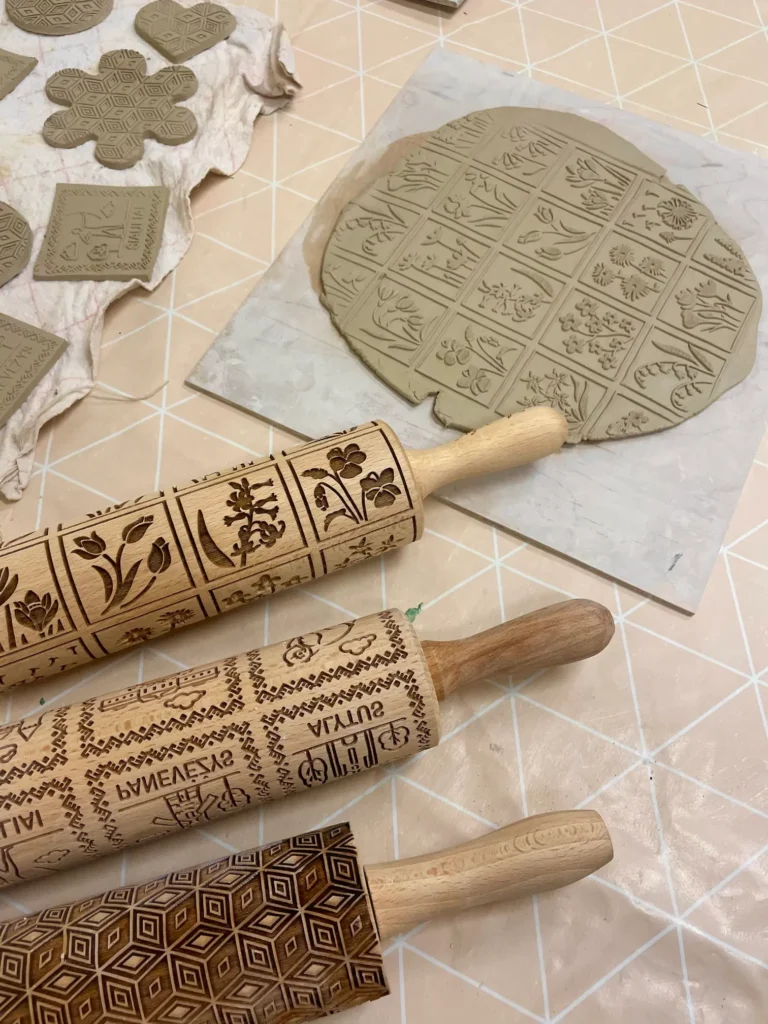
The L size gives you a bit more room to move. Its engraved part is 25 cm (10 in) and the total length 43 cm (17 in), which means you can cover more surface in one roll without having to stop and readjust. Pottery artists especially love this one, because it makes it easier to texture wide slabs, plates, and trays (our pottery rolling pin guide has slab thickness tips). Bakers use it too when they’re rolling large sheets of dough or want to finish a batch faster. It has the same deep pattern and smooth feel, just a longer reach.
Choose the MINI for kids and small projects
We also make mini embossed rolling pins for small hands and short projects. They’re light, easy to handle, and perfect for kids who like to join in or for trying out new patterns on a small piece of dough. The 11 cm (4.3 in) pattern is just right for a few cookies, polymer clay jewelry, play dough or a handful of ornaments, and at 24 cm (9.4 in) long it fits easily in a kitchen drawer.
How long is a rolling pin? Standard rolling pin sizes
There is no single standard rolling pin size, but most full-size wooden rolling pins are roughly 15 to 20 inches (38 to 50 cm) long, with a diameter of around 2 inches (5 cm). The type of pin changes how much of that length you can actually use:
- Handled rolling pins put part of their length into the handles, so the rolling surface is usually about 10 to 12 inches (25 to 30 cm).
- French and straight pins have no handles and roll along almost their full length, often around 18 to 20 inches (45 to 50 cm).
- Embossed rolling pins are measured two ways: total length and pattern length. Our M is a standard full-size 15 in (38 cm) overall, with an 8 in (20 cm) pattern.
An embossed pin is a finishing tool, so you’ll still want a plain rolling pin to roll the dough flat before printing the pattern. A plain pin with thickness rings, or a pair of rolling guides, makes it easy to get an even 1 cm (½ in) sheet first. If you already own a plain pin, its size doesn’t matter much; the embossed pin only needs to cover the width of your sheet.
Does rolling pin diameter matter?
Yes, a little. A thicker barrel is heavier and rolls more smoothly with less effort, and a bigger circumference means a longer stretch of pattern before it repeats. Our M and L pins are 6 cm (2.4 in) across, slightly thicker than many plain pins, which helps press the pattern evenly. The MINI is 4.5 cm (1.8 in), light enough for a child to control.
Rolling pin size FAQ
What is the standard size of a rolling pin?
There is no official standard. Most full-size rolling pins are about 15 to 20 inches (38 to 50 cm) long and around 2 inches (5 cm) thick. Our REGULAR (M) embossed rolling pin is 38 cm (15 in) long and 6 cm (2.4 in) thick.
What size embossed rolling pin is best for cookies?
The REGULAR (M). Its 20 cm (8 in) pattern covers a typical sheet of cookie dough in one pass and is easy to control on a kitchen counter.
Is every pattern available in every size?
Yes. All our patterns can be made on MINI, M and L rolling pins. If you have a question about a size, just contact us.
Whichever size you choose, the engraving depth and pattern quality are the same: clean, detailed, and made to last. It really just depends on what you love doing most: baking, crafting, or both. Browse our embossed rolling pins by pattern, and if you’d like the measurements in one place, they are also listed in our FAQ.
Algis Crafts